
Binaural Beats for Sleep: Frequencies, Protocol, and Deep Rest

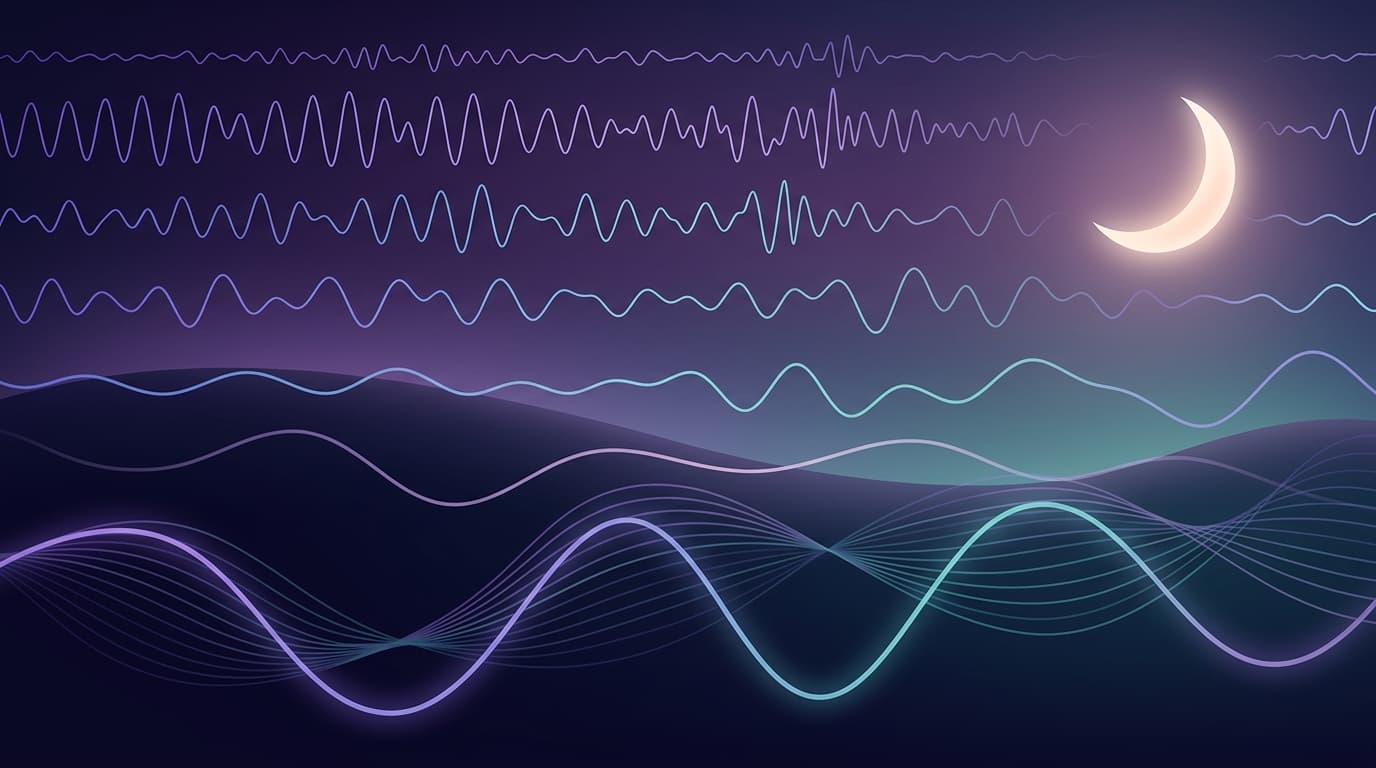
If your brain does not know how to stop at bedtime, binaural beats are one of the few audio tools with actual research behind them. Not a miracle cure, and not a replacement for real sleep hygiene. But a measurable, evidence-informed way to nudge your nervous system toward the states that support deep, restorative rest.
This is the complete guide. What delta and theta waves do while you sleep, which frequencies tend to help and which work against you, a practical listening protocol (timing, headphones, volume, duration), and an honest comparison with the other big family of sleep audio: rain, waves, and pink noise. If you only want the experiment, skip to the end. If you want to understand what you are doing and why, start here.
How Binaural Beats Work (Quickly)
When you hear two slightly different frequencies, one in each ear through headphones, your brain perceives a third, phantom frequency equal to the difference between them. Play 200 Hz in your left ear and 203 Hz in your right, and your brain generates a 3 Hz beat that does not exist in the air. That 3 Hz perception sits in the delta range, the frequency band associated with deep sleep.
The phenomenon was described for a general audience by Gerald Oster in Scientific American in 1973, and the idea that followed is called entrainment: with sustained listening, broader brain activity tends to drift toward the beat frequency. The EEG evidence here is real but more modest than most sleep apps suggest. Intracranial recordings by Becher and colleagues (2015, European Journal of Neuroscience) found that brief, quiet monaural and binaural beats at several frequencies measurably shifted EEG power and phase synchronization in temporal and mediotemporal regions, though mostly as decreases rather than increases. A 2020 study by Orozco Perez and colleagues in eNeuro confirmed that binaural beats entrain the auditory cortex at the beat frequency, though more weakly than ordinary monaural beats did, and without any measurable change in mood. In plain terms: the brain does follow the beat, the effect is small, and binaural beats are not uniquely magical.
One thing is not negotiable: this only works with headphones. Played through speakers, the two tones mix in the air before they reach you, and the separation between ears that the mechanism depends on is gone. (For the full mechanism and the five brainwave bands, see what binaural beats are.)
What Your Brain Is Doing in Deep Sleep
To use sleep audio well, it helps to know what you are trying to protect. The five standard brainwave bands run from slowest to fastest: delta (0.5 to 4 Hz), theta (4 to 8 Hz), alpha (8 to 13 Hz), beta (13 to 30 Hz), and gamma (above 30 Hz). Delta is the slowest, and it appears in recognizable amounts only during the deepest stage of sleep, officially called N3 or slow-wave sleep. The waves are large in amplitude, meaning many neurons are firing together in synchrony, and very slow. You do not generate them while awake.
Slow-wave sleep is concentrated in the first half of the night. If you sleep from eleven to seven, most of your delta activity happens between eleven and three. A night cut short at the end costs you REM and light sleep. A night cut short at the beginning costs you the deep sleep your brain and body need most.
Research over the past two decades has built a detailed picture of what happens in that window, and the list is load-bearing.
Memory consolidation. A widely cited 2010 review in Nature Reviews Neuroscience by Diekelmann and Born laid out the role of slow-wave sleep in moving information from hippocampus-dependent short-term storage into cortical long-term memory. If you studied something today and want it stable tomorrow, deep sleep is doing the filing.
Glymphatic clearance. A 2013 paper by Xie and colleagues in Science showed, in mice, that the space between brain cells expands during sleep and that cerebrospinal fluid flushes through it far more effectively, clearing metabolic waste including beta-amyloid, the protein implicated in Alzheimer's disease. Human work on this system is still developing, but the direction is consistent: sleep is when the brain cleans house.
Growth hormone and repair. Pulses of growth hormone are released during slow-wave sleep, driving tissue repair and muscle recovery. Athletes, older adults working to preserve muscle, and anyone healing from injury all have a stake in deep sleep. Immune signaling is also supported during this stage, which is part of why poor sleep and frequent illness travel together.
How much you need. Slow-wave sleep makes up roughly 13 to 23 percent of total sleep in healthy young adults, somewhere around 70 to 110 minutes on an eight-hour night. The amount declines with age; by your fifties and sixties it can be roughly half what it was in your twenties. Sleep trackers estimate deep sleep from heart rate and movement rather than actual EEG, so they are reasonable for spotting trends across weeks and unreliable for judging a single night. Trust the trend, not the number. More useful than any metric: how you feel on waking and whether your recovery matches your workload.
Which Frequencies Support Sleep
Not every brainwave state serves sleep. The research points to specific ranges.
Delta (0.5 to 4 Hz). This is the range associated with the deepest, most physically restorative sleep. The best-known study here is a 2018 paper by Jirakittayakorn and Wongsawat in Frontiers in Human Neuroscience. In 24 participants, a 3 Hz binaural beat played from the first epoch of N2 (light sleep) until deep sleep was detected was followed by a longer stretch of N3, a shorter stretch of N2, and a quicker arrival into deep sleep than in the sham-stimulus control group. Small study, one experimental night, but it is the most direct evidence that delta beats can shape sleep architecture. If deep sleep is the goal, this is where you aim.
Theta (4 to 8 Hz). Theta corresponds to the hypnagogic state, the liminal zone between wakefulness and sleep where your mind drifts into imagery and your body starts its shutdown sequence. It is the useful range for the transition into sleep, especially if your trouble is falling asleep rather than staying asleep. A 6 Hz theta beat is a reasonable choice for the first 10 to 20 minutes of a listening session.
Alpha (8 to 13 Hz). Alpha is a bridge state: relaxed, eyes closed, calm but still conscious. It is not a sleep frequency, but it is valuable as a lead-in. If you are wound up and need to come down, starting around 10 Hz gives your nervous system a stepping stone before theta and delta.
The common mistake is jumping straight to the deepest frequency without giving your brain time to transition. A gradual descent (alpha, then theta, then delta) tends to feel more organic than slamming into 2 Hz delta while you are still mentally caffeinated. It also mirrors the natural trajectory of early-night sleep.
Frequencies to skip at bedtime. Beta (13 to 30 Hz) is the waking, analytical state. Gamma (30 Hz and up) is associated with high-alertness processing. Both pull in the opposite direction. The same goes for tracks that cycle rapidly through frequencies or layer energizing music over the tones. The entire point of sleep audio is monotony. Anything that keeps your attention engaged is working against you.
What the Research Supports
An honest reading of the evidence: the strongest research on binaural beats is not about sleep at all. A 2019 meta-analysis by Garcia-Argibay, Santed, and Reales in Psychological Research pooled 35 effect sizes from 22 studies and found a consistent medium overall effect (g = 0.45) across memory, attention, anxiety, and pain perception, none of which measured sleep directly. Sleep benefits are plausibly downstream of the anxiety piece: a calmer pre-sleep state makes sleep onset easier. (If anxiety is the main thing standing between you and sleep, binaural beats for anxiety covers that angle in depth.)
For sleep specifically, the Jirakittayakorn delta study is positive and other studies are mixed. Expect modest gains, not miracles. Sleep is a whole-body process shaped by dozens of variables, and audio is one small input that stacks with good sleep hygiene rather than replacing it. Anyone promising more than that is overselling.
A Practical Listening Protocol
If you decide to try binaural beats for sleep, these are the settings that give the tool its best chance.
Headphones, always. Comfortable sleep headphones (flat, fabric-based, or sleep-specific models) work better than earbuds for overnight use. If you would rather not sleep in them, use the binaural track for the 20 to 30 minutes before sleep, then switch to a speaker or to silence.
Low volume. Entrainment does not require loud playback, and too loud keeps you awake on its own. You want the tones at the edge of awareness: present enough for your brain to register, quiet enough to fade into the background.
Timing. Start 20 to 30 minutes before you want to be asleep, in the falling-asleep window when your brain is still active enough to follow the beat but already descending. Once you are asleep, the entrainment effect matters less.
Duration. Entrainment does not happen in 30 seconds. The 2019 meta-analysis found that longer time under exposure produced larger effects, and that listening before a task worked better than listening only during it. A two-minute "reset" is unlikely to do much. Thirty minutes is a sensible session length; the track can fade to silence or loop quietly through the night at very low volume, depending on whether you like audio running while you sleep.
Consistency. Like any nervous system practice, this builds through repetition. Your brain learns to associate the sound with a specific state, and after a few weeks of regular bedtime use the audio itself becomes a sleep cue.
A Template for a 30-Minute Sleep Track
- Minutes 0 to 10: 10 Hz alpha beats, soft ambient music underneath, optional slow spoken affirmations about safety and release. This phase brings you out of waking mental activity.
- Minutes 10 to 20: Shift to 6 Hz theta, music slower and more minimal, affirmations shorter and more sparse. This is the hypnagogic transition.
- Minutes 20 to 30: 3 Hz delta, minimal music, no spoken content, a continuous solfeggio tone layered for grounding. By this point you are asleep or very close.
Sleep Sounds vs Binaural Beats
Walk into the sleep section of any audio app and you will find two broad families: ambient sleep sounds (rain, ocean, pink noise, brown noise, crickets) and binaural beats. They get lumped together as "sleep audio," but they work through completely different mechanisms, have different research bases, and shine in different situations.
How sleep sounds work. Mostly through masking. Your brain keeps processing sound while you sleep, and sudden changes (a door, a truck, a partner rolling over) can fragment sleep through micro-arousals. Steady broadband sound fills the acoustic field so small changes do not stand out. Pink noise, with energy spread evenly across octaves, is especially good at this because it resembles the spectral shape of many environmental sounds. Brown noise goes warmer still; white noise is flatter and can sound harsh. There is also a soothing effect from familiar natural patterns. A 2017 study by Gould van Praag and colleagues in Scientific Reports found that listening to natural sounds, compared with artificial ones, increased a heart-rate-variability marker of parasympathetic (rest-and-digest) activity and shifted connectivity within the default mode network, the brain's inward-focused, self-referential system. The size of the change depended on the listener's baseline connectivity and parasympathetic tone.
Some acoustic input may do more than mask. In 2013, Ngo and colleagues reported in Neuron that short bursts of sound timed precisely to the up-phase of slow oscillations deepened those oscillations and improved overnight memory in young adults, while the same sounds played out of phase did nothing. A 2017 study from Northwestern University by Papalambros and colleagues in Frontiers in Human Neuroscience extended this to 13 adults aged 60 to 84 using pink-noise pulses, with better overnight word recall on the stimulation night. That is closed-loop stimulation under lab EEG, not a pink noise track on a speaker, but it suggests the right sound at the right moment can support deep sleep rather than just cover up the neighbors.
Where each one earns its place. Sleep sounds are the better default when the disruption is environmental: noisy streets or thin walls, hotel stays, an infant down the hall, or a light sleeper who wakes at every creak. Binaural beats do not mask anything, so they will not help with that. Sleep sounds also win when headphones are not comfortable for you, since a bedside speaker is all they need.
Binaural beats earn their place when the problem is more neurological than environmental: a racing mind that will not downshift at sleep onset, sleep that feels shallow and unrefreshing despite enough hours, or a high-arousal, anxious pre-sleep state where alpha or theta beats paired with slow breathing help the nervous system transition.
Using both. Most people do best with a layered approach, because the two families work on different dimensions. Binaural beats through headphones for the first 30 to 40 minutes, graduated from alpha through theta to delta, then pink noise or nature sounds on a speaker through the rest of the night to handle the unpredictable disruption window. Or a single track that runs binaural frequencies underneath an ambient layer: the ambient layer masks, the binaural layer entrains. This is how most well-built commercial sleep tracks are structured.
Layering Binaural Beats with Other Audio
Pure binaural beats (just the two tones, nothing else) feel clinical and strange to many listeners, which is why effective sleep tracks usually put the tones underneath something softer.
Ambient music. Slow (50 to 60 BPM), tonally stable, instrumentally simple music gives your attention something soft to rest on while the beats work underneath.
Solfeggio tones. A continuous tone such as 174 Hz, 285 Hz, or 396 Hz adds a harmonic grounding layer and pairs comfortably with delta-range beats.
Spoken affirmations. For some people, gentle spoken content during the transition quiets mental chatter. The script matters: short, slow, repetitive phrases. "I am safe. I am letting go. My body is resting." Not a podcast, not a lecture, not a guided meditation with directions. A simple, repeating anchor the mind can follow down.
Nature sounds. Rain, wind, or water layer well over binaural beats, soften the pure-tone feel, and provide consistent texture through the night.
What Disrupts Deep Sleep, and What Supports It
Audio is a polish. It makes a good sleep setup better and cannot rescue a bad one, so it is worth knowing where the bigger levers are.
Alcohol. It sedates you into sleep faster, which feels useful, but it fragments the second half of the night and degrades sleep quality overall. Even a couple of drinks with dinner shows up in how you wake. No audio track offsets this.
Late, heavy meals. Eating within two to three hours of bed keeps digestion busy during the window when slow-wave sleep should be consolidating.
Heat. Deep sleep depends on core body temperature dropping. A hot room, heavy bedding, late intense exercise, or a hot shower right before bed can all delay that drop. A bedroom in the low to mid 60s Fahrenheit, kept dark, outperforms most audio interventions.
Caffeine. With a half-life of roughly five to seven hours in most adults, an afternoon cup can reduce deep sleep even when it did not feel like it kept you awake. Earlier cutoffs help more than later ones.
Irregular schedules. Circadian disruption flattens deep sleep more than any single late night. Consistent sleep and wake times, including weekends, set up the architecture of the coming night. Seven hours on a steady schedule often produces more slow-wave sleep than eight on a chaotic one.
On the supportive side: physical activity earlier in the day reliably increases slow-wave sleep on the nights that follow; bright light in your eyes within the first hour of waking anchors the circadian rhythm that drives deep sleep; and practices that lower baseline stress (breathwork, meditation, time outside) help indirectly but dependably, because elevated evening cortisol suppresses deep sleep.
What Binaural Beats Will Not Transform
Honesty about limits. Binaural beats will not overcome chronic sleep deprivation caused by schedule disruption. If you are consistently getting to bed too late, no audio tool can manufacture sleep time you are not giving yourself. They will not compensate for heavy caffeine, alcohol close to bed, or a phone screen glued to your face until lights-out.
They are also not a treatment. Sleep apnea, persistent insomnia, and other clinical sleep conditions need evaluation from a licensed professional, and nothing in this guide is a substitute for that care. Audio can be a supportive layer alongside treatment. It does not replace it.
Making the Practice Yours
A generic binaural track on a streaming site does generic work. It will probably help. It will also feel interchangeable with a thousand other tracks, which is why so many people stop using it after a week, and why the signal fades as your nervous system adapts to it.
A personalized sleep track changes the equation. The binaural band matched to your actual sleep goal (delta-dominant for deep sleep, theta-heavy for sleep onset, alpha-led for an evening wind-down). A graduated structure that moves from theta to delta over 30 to 40 minutes, the way you actually fall asleep. Background music you genuinely find calming rather than whatever sounds generic-spa. A brief spoken intention at the start, in a voice you trust, including your own, if that helps you land, or silence if it does not. Length matched to your real sleep onset window.
The tool you use every night, consistently, across months, is the one that changes your baseline. Deep sleep responds to consistency more than to any specific intervention.
MindScript is built for exactly this. You pick the binaural band for the heart of the track, add a solfeggio frequency if a specific tone resonates with you, choose the background music you want to hear, and optionally open with your own voice for an intention-setting start before the instrumental layers take over. The result is an audio practice built around your nervous system, not a stranger's. You can explore the binaural beats and affirmations builder to see how the layers fit together.
Starting Tonight
If you want to test this for yourself, here is a structured week that compares the approaches instead of guessing.
- Nights 1 and 2: pink noise or nature sounds through a bedside speaker, all night, at a volume you can notice but that does not dominate.
- Nights 3 and 4: delta-range binaural beats (2 to 4 Hz) through headphones for the first 30 minutes, low volume, then headphones off and let the room go quiet.
- Nights 5 and 6: a layered track, ambient music with a delta binaural layer underneath, for the first hour, fading out.
- Each morning, rate your sleep on a 1 to 10 scale before looking at any tracker data. Note sleep onset, middle-of-the-night wake-ups, and how you feel on waking.
- At the end of the week, compare the three against your baseline. The best approach is the one that reliably produces better mornings for you, not the one with the best research headline.
Alongside the audio, the hierarchy the research supports is simple: a consistent sleep and wake time, morning light, a cool dark room, less alcohol, an earlier caffeine cutoff. Those are mostly free. Then, if the audio experiment lands, the next step is making the practice yours. A custom track built around your actual sleep challenge is where the casual experiment turns into a real tool. The science supports it. The consistency delivers it. Your sleep does the rest.
References
- Oster G (1973). Auditory beats in the brain. Scientific American, 229(4), 94-102. https://doi.org/10.1038/scientificamerican1073-94
- Becher AK, Höhne M, Axmacher N, Chaieb L, Elger CE, Fell J (2015). Intracranial electroencephalography power and phase synchronization changes during monaural and binaural beat stimulation. European Journal of Neuroscience, 41(2), 254-263. https://doi.org/10.1111/ejn.12760
- Orozco Perez HD, Dumas G, Lehmann A (2020). Binaural beats through the auditory pathway: From brainstem to connectivity patterns. eNeuro, 7(2), ENEURO.0232-19.2020. https://doi.org/10.1523/ENEURO.0232-19.2020
- Diekelmann S, Born J (2010). The memory function of sleep. Nature Reviews Neuroscience, 11(2), 114-126. https://doi.org/10.1038/nrn2762
- Xie L, Kang H, Xu Q, Chen MJ, Liao Y, Thiyagarajan M, O'Donnell J, Christensen DJ, Nicholson C, Iliff JJ, Takano T, Deane R, Nedergaard M (2013). Sleep drives metabolite clearance from the adult brain. Science, 342(6156), 373-377. https://doi.org/10.1126/science.1241224
- Jirakittayakorn N, Wongsawat Y (2018). A novel insight of effects of a 3-Hz binaural beat on sleep stages during sleep. Frontiers in Human Neuroscience, 12, 387. https://doi.org/10.3389/fnhum.2018.00387
- Garcia-Argibay M, Santed MA, Reales JM (2019). Efficacy of binaural auditory beats in cognition, anxiety, and pain perception: a meta-analysis. Psychological Research, 83(2), 357-372. https://doi.org/10.1007/s00426-018-1066-8
- Gould van Praag CD, Garfinkel SN, Sparasci O, Mees A, Philippides AO, Ware M, Ottaviani C, Critchley HD (2017). Mind-wandering and alterations to default mode network connectivity when listening to naturalistic versus artificial sounds. Scientific Reports, 7, 45273. https://doi.org/10.1038/srep45273
- Ngo HV, Martinetz T, Born J, Mölle M (2013). Auditory closed-loop stimulation of the sleep slow oscillation enhances memory. Neuron, 78(3), 545-553. https://doi.org/10.1016/j.neuron.2013.03.006
- Papalambros NA, Santostasi G, Malkani RG, Braun R, Weintraub S, Paller KA, Zee PC (2017). Acoustic enhancement of sleep slow oscillations and concomitant memory improvement in older adults. Frontiers in Human Neuroscience, 11, 109. https://doi.org/10.3389/fnhum.2017.00109
Frequently Asked Questions
What binaural beat frequency is best for sleep?
Do binaural beats really help you fall asleep?
Do I need headphones for binaural beats to work?
How long before bed should I start binaural beats?
Which is better for sleep: binaural beats or sleep sounds?
What do delta waves do for sleep?

Written by
Founder, MindScript
David Sunseeker is the founder of MindScript. He has used binaural beats and meditation for more than twenty years, and built MindScript so anyone can write exactly what they need to hear and listen to it in a voice they choose, including their own. He writes under a pen name and is not a clinician; nothing on this blog is a substitute for care from a licensed professional.
Related Articles
 Sound Science
What Are Binaural Beats? The Science Behind Sound-Based Brain Training
Binaural beats use a subtle auditory illusion to guide your brainwaves into states of deep focus, relaxation, or sleep. Here's how they work and what the research says.
 Sound Science
Do Affirmations Work While You Sleep? What the Science Says
The promise of transformation while you sleep is seductive. But the real science points to a specific window, the hypnagogic transition, where audio affirmations have genuine power.
 Techniques & Methods
Sleep Music for Trauma Survivors: How to Calm a Hypervigilant Mind
Trauma keeps the nervous system on watch long after dark, flooding the body with stress chemistry and making sleep feel unsafe. Here is why that happens, how sound reaches the vagus nerve and brainstem directly, and how a predictable, voice-led sleep audio environment can help a hypervigilant body learn to rest.